Start with permission and a purpose
An annual review is a chance to make the relationship useful again. Start by asking whether a short update would help. The homeowner might be staying put, planning renovations or considering a move years from now.
ADAPT TO YOUR RELATIONSHIP
“Would a short review of your home’s estimated value and equity be useful this year? We can also talk through any plans you have for the home.”
Use your normal brokerage contact process and respect the person’s preferences. A review does not need to become a listing appointment to be worthwhile.
Prepare the evidence before the report
Bring recent comparable sales, the dates you checked them and the reasons they relate to this home. Note meaningful differences in condition, size, location and timing. A range is more honest than presenting an unsupported exact figure.
- Confirm the property details with the homeowner.
- Ask for current mortgage and drawn HELOC balances if they want an equity estimate.
- Identify other debt secured against the home that belongs in the calculation.
- Keep the evidence date and limitations visible.
Do not ask for account passwords. Store financial information only through your approved process. If balances are unavailable, leave that part incomplete and arrange a follow-up rather than guessing.
Separate value, equity and a sale scenario
Estimated value is a judgement supported by your evidence. Estimated equity subtracts the entered secured debt. An optional sale scenario also subtracts entered selling costs. Those are three different questions.
In our fictional example, a value range of $850,000–$900,000 and secured debt of $435,000 produces estimated equity of $415,000–$465,000. Adding $34,500 of illustrative selling costs reduces estimated proceeds to $380,500–$430,500, before the excluded items.
Use the free equity versus sale proceeds explorer to see the arithmetic. These example figures are not a valuation, a recommended fee or a tax estimate.
Share the report and agree on one next step
Walk through the assumptions before sending a finished report. Ask which parts of the homeowner’s plans have changed. They may want updated evidence, a conversation about timing or no action at all.
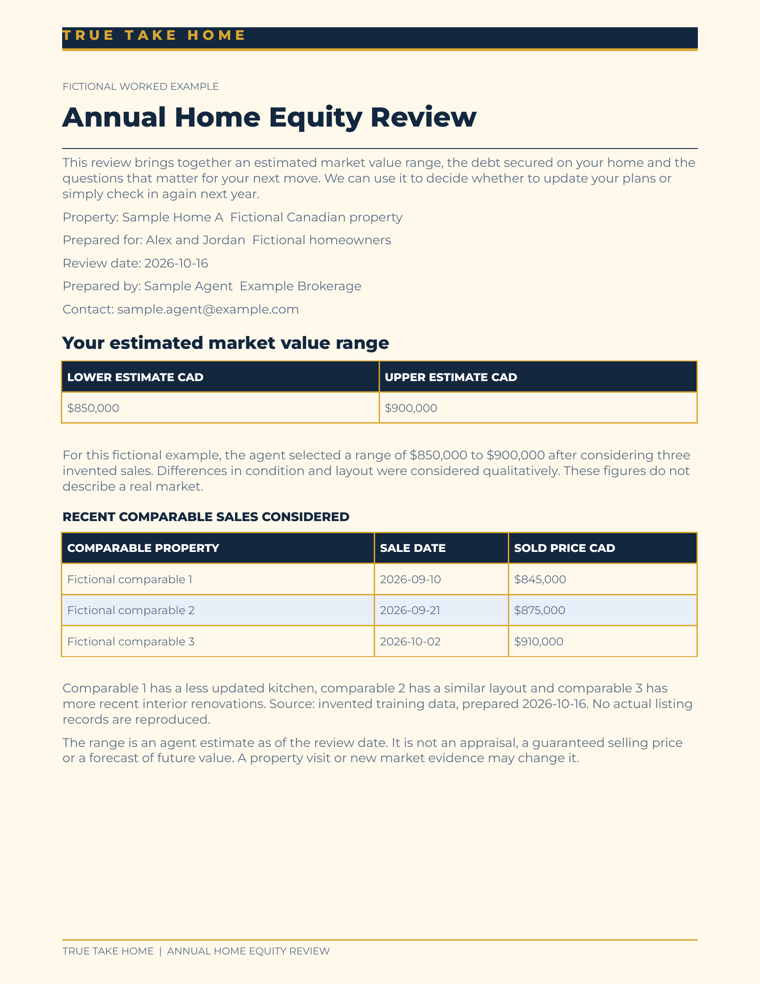
The Annual Home Equity Review Kit includes a separate editable homeowner report. Check the workbook results, copy them into that report manually and check them again before sharing. The report does not automatically sync with the spreadsheet.
Record the next step and date you agreed. “Send updated comparable sales next Thursday” is more useful than “keep in touch.” If they do not want further follow-up, record that preference and honour it.